
Introduction
The Bank for International Settlements (BIS) describes money not as a physical object but as a social technology — a system societies use to coordinate economic behavior, build trust, and sustain exchange. This reframing shifts attention away from the medium of money and toward the institutions and governance structures that make it function. In an era where financial systems are becoming increasingly digital, global, and interconnected, understanding the true nature of money is more important than ever. The question is no longer simply how money is created or transferred, but why societies accept it, how its credibility is maintained, and what conditions allow monetary systems to remain stable as technology evolves.
Money as a Social Construct
From the BIS perspective, the value of money has never been derived from its physical composition. Whether societies used gold, printed notes, or digital records, what mattered was not the substance itself but the shared trust placed in the issuing authority. Money is ultimately a collective agreement — a belief upheld by institutions that ensure obligations are honored.
Gold gained acceptance because communities believed in its scarcity and durability. Fiat currencies operate because people trust central banks to maintain purchasing power. Even in digital payment systems, credibility arises not from the medium but from governance, transparency, and institutional reliability. In this view, money is less an object and more a coordination mechanism — a tool that enables societies to settle obligations efficiently through mutual confidence.
The Institutional Foundations of Money
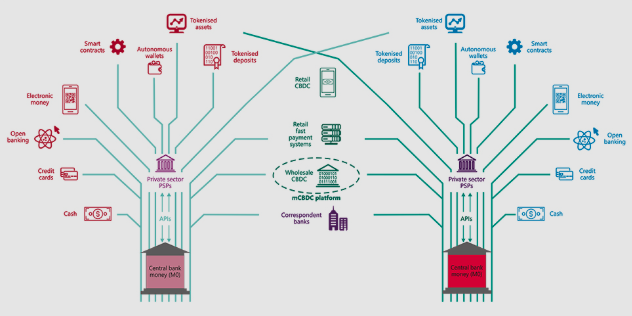
Although money appears simple in everyday life — a balance on a screen or a physical note — its functionality depends on a multilayered institutional architecture. BIS highlights that beneath each transaction lies an interconnected network of payment systems, settlement mechanisms, central banks, commercial banks, and legal frameworks.
Money works because these systems work.
Its stability does not come from the token itself but from the operational infrastructure that guarantees redemption, validates transactions, and preserves public trust. When institutional reliability falters — through political instability, weak governance, or lack of transparency — the perceived value of money can deteriorate rapidly. This demonstrates that money’s essence is inseparable from the credibility of the institutions that support it.
Technology and the Evolution of Monetary Systems
Technological innovation does not redefine the nature of money; instead, it expands the architecture through which monetary systems operate. Digital payments, mobile banking, real-time settlement tools, and emerging digital currencies all reflect the same foundational requirements: trust, verification, governance, and accountability.
Whether money moves on paper, centralized databases, or distributed networks, its legitimacy depends on the system’s ability to fulfill obligations reliably. BIS therefore views technological change as an evolution of financial infrastructure rather than a reinvention of monetary principles. Technology may accelerate speed, accessibility, and interoperability, but the fundamental social and institutional foundations remain constant.
Why the Nature of Money Matters Today
As financial systems expand across borders and migrate toward digital frameworks, the conversation around money becomes less about its format and more about the design of the systems that sustain it. BIS emphasizes that the critical questions societies must confront revolve around institutional authority, the durability of trust, and the governance mechanisms that ensure long-term stability. These discussions naturally extend to how new technologies integrate with existing financial infrastructures without compromising the trust that underpins monetary value.
The future of global monetary systems will be shaped by the answers to these questions far more than by the visual or technical characteristics of currency. Understanding the nature of money clarifies why some systems thrive while others deteriorate, and how trust can be preserved in increasingly complex, technology-driven environments. In a rapidly evolving digital economy, the essence of money continues to rest on shared belief, coherent governance, and institutional strength.
Conclusion
From the BIS viewpoint, money is fundamentally a trust-based public good. Its power does not come from its physical or digital representation but from the institutions, rules, and governance structures that make it credible. As new technologies reshape the ways societies interact with money, the foundational nature of money remains unchanged: a social framework for coordinating exchange, sustaining economic relationships, and enabling long-term planning.
Understanding this nature provides not only a perspective on the past but also a guide to where global monetary systems may be heading — shaped by innovation, institutional integrity, and the enduring human requirement for trust.
References
Bank for International Settlements — Annual Reports & Working Papers
BIS – The Future of Money (Research Series)
Cambridge Centre for Alternative Finance — Monetary Systems Analysis
OECD — Studies on Payment Systems and Financial Infrastructure